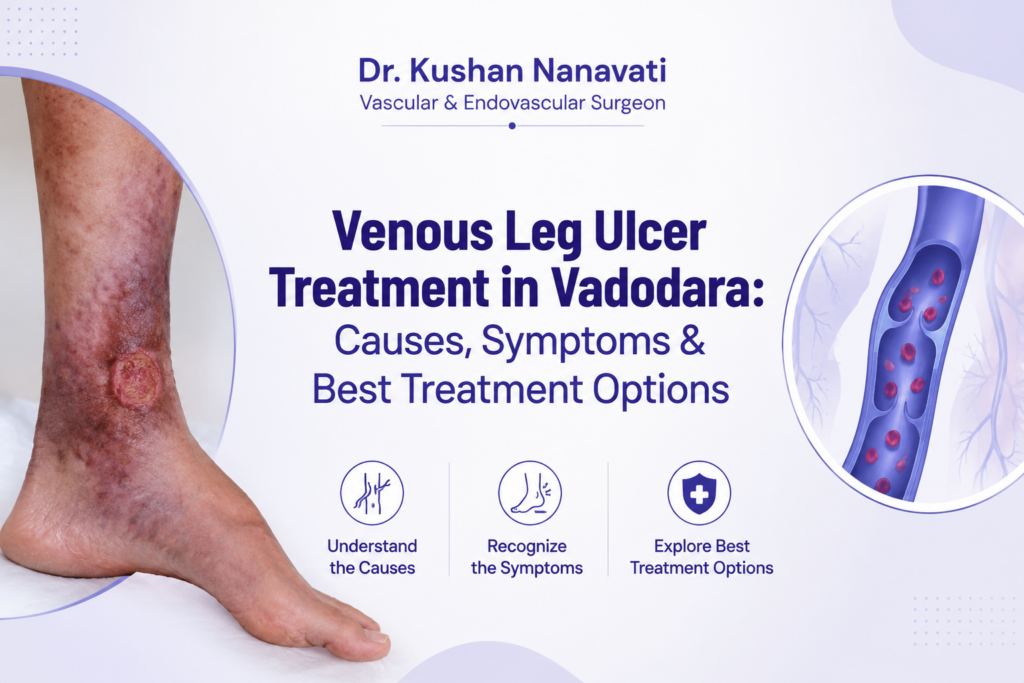

If you’ve been living with a slow-healing wound on your lower leg or ankle, you’re not imagining things – it’s not “just a wound that’s taking time.” In most cases, a sore that won’t close on its own is a venous leg ulcer, caused by poor blood flow in the veins of the leg. Left untreated, these ulcers tend to get bigger, more painful, and more prone to infection.
The good news: with the right treatment approach, most venous leg ulcers heal within a few months, and recurrence can be prevented long-term. In this guide, Dr. Kushan Nanavati, Vascular Surgeon in Vadodara, breaks down what causes venous leg ulcers, how to recognize the symptoms early, and which treatments actually work.
What Is a Venous Leg Ulcer?
A venous leg ulcer is an open sore that develops on the lower leg – most commonly around the inner ankle – when damaged or weak vein valves stop blood from flowing efficiently back to the heart. Blood pools in the lower leg, pressure builds up in the veins, and over time this pressure damages the skin, leading to a wound that struggles to heal.
Venous ulcers are the most common type of leg ulcer, accounting for the majority of chronic leg wounds seen in vascular surgery clinics. They are a symptom of an underlying vein problem, not a standalone skin condition, which is why treating the wound dressing alone rarely solves the problem – the vein issue driving it also needs to be addressed.
What Causes Venous Leg Ulcers?
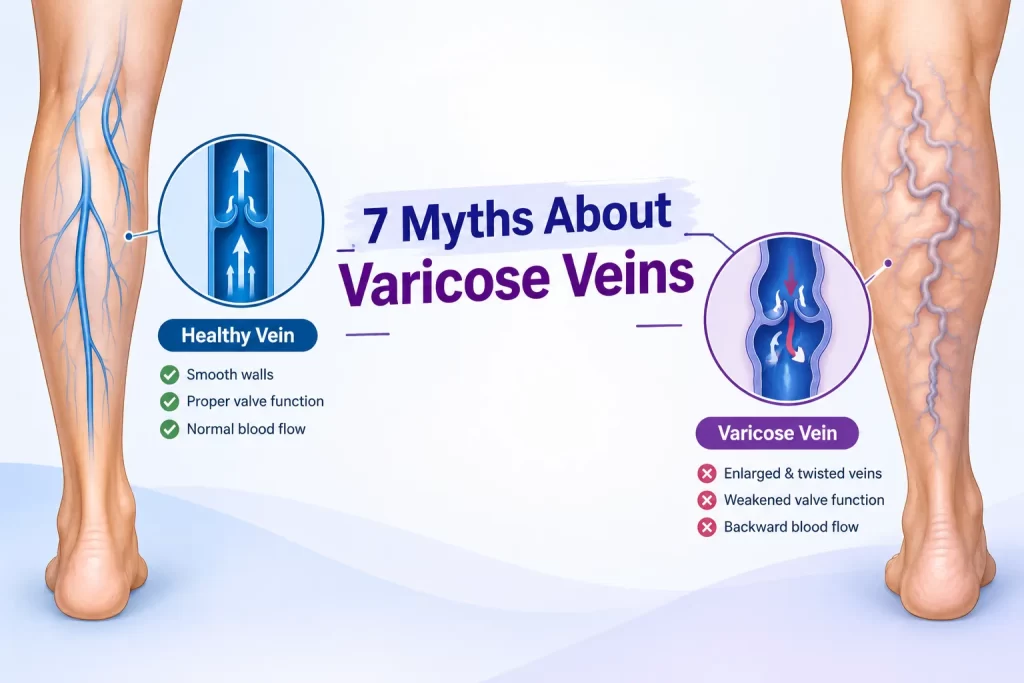
The root cause of a venous leg ulcer is chronic venous insufficiency – a condition where the one-way valves inside your leg veins fail to close properly, allowing blood to flow backward and pool in the lower leg. Several factors increase the risk of developing this condition and, eventually, an ulcer:
- Varicose veins – enlarged, twisted veins are often the earliest visible sign of venous insufficiency
- Previous deep vein thrombosis (DVT) – a blood clot in the leg can permanently damage vein valves
- Prolonged standing or sitting – jobs that involve long hours on your feet or seated increase pressure in leg veins
- Obesity – excess weight adds pressure on the venous system
- Older age – vein walls and valves naturally weaken over time
- Family history – venous disease often runs in families
- Previous leg injury or surgery – can damage veins directly
- Pregnancy – increases pressure on pelvic and leg veins
Understanding the cause matters because effective treatment targets the vein problem itself, not just the surface wound.
Symptoms of Venous Leg Ulcers You Shouldn't Ignore
Venous leg ulcers rarely appear overnight. They usually develop gradually, and catching the early warning signs can prevent a full-blown ulcer from forming. Watch for:
- Persistent swelling in the ankle or lower leg, especially by evening
- Skin discoloration – a brownish or reddish-brown staining around the ankle
- Itchy, dry, or flaky skin on the lower leg
- A feeling of heaviness, aching, or throbbing in the legs
- Hardening or thickening of the skin around the ankle
- A shallow, irregular-shaped open wound, usually near the inner ankle
- Wound discharge or a wound that weeps fluid
- Pain that gets worse when standing and improves when the leg is raised
If you notice a wound that hasn’t started healing within 2 weeks, or one that’s getting larger, it’s time to see a vascular surgeon rather than waiting it out.
How Are Venous Leg Ulcers Diagnosed?
Proper diagnosis is the foundation of effective treatment. At a vascular surgery consultation, this typically involves:
- Clinical examination of the wound, surrounding skin, and leg
- Venous Doppler ultrasound – a painless scan that maps blood flow in the leg veins and identifies exactly which valves are failing
- Ankle-Brachial Pressure Index (ABPI) – a quick test to rule out arterial blood flow problems, since arterial ulcers need a completely different treatment approach
- Wound assessment – measuring size, depth, and checking for signs of infection
This diagnostic step is critical: treating a venous ulcer as if it were a diabetic or arterial ulcer (or vice versa) can actually worsen the wound.
Best Treatment Options for Venous Leg Ulcers
Modern vascular surgery offers several effective, minimally invasive treatments. The right one for you depends on the severity of the underlying vein disease and the condition of the wound itself.
1. Compression Therapy
Compression bandages or stockings are usually the first line of treatment. They apply graduated pressure to the leg, helping push blood back up toward the heart, reducing swelling, and creating the right environment for the ulcer to heal. Compression alone helps many smaller ulcers heal, though it doesn’t fix the underlying faulty veins.
2. Wound Care and Dressings
3. Endovenous Laser Treatment (EVLT) / Radiofrequency Ablation (RFA)
4. Sclerotherapy
5. Surgical Vein Correction
6. Medications
7. Lifestyle and Home Care Measures
Leg elevation, regular walking, weight management, and avoiding long periods of standing all support faster healing and help prevent new ulcers from forming.
Most treatment plans combine more than one of these approaches – for example, sealing off the faulty vein with EVLT while wearing compression stockings and following wound care instructions.
How Long Does a Venous Leg Ulcer Take to Heal?
Can Venous Leg Ulcers Come Back After Treatment?
Why See a Vascular Surgeon for a Leg Ulcer?
Dermatologists and general physicians can manage wound dressings, but a Vascular Surgeon in Vadodara is trained specifically to diagnose and treat the underlying vein disease causing the ulcer. Dr. Kushan Nanavati specializes in identifying the exact source of venous insufficiency through Doppler ultrasound and offers the full range of modern treatments – from compression therapy to minimally invasive procedures like EVLT and sclerotherapy – tailored to each patient’s condition, so the ulcer heals and stays healed.
If you or a family member in Vadodara has a slow-healing leg wound, don’t wait for it to worsen. Early evaluation leads to faster healing, less discomfort, and a much lower chance of complications like infection or recurrence.
Frequently Asked Questions (FAQs)
1. What does a venous leg ulcer look like?
2. Is a venous leg ulcer serious?
3. Are venous leg ulcers painful?
4. Can venous leg ulcers be treated without surgery?
5. What is the fastest way to heal a venous leg ulcer?
6. Which doctor should I consult for a leg ulcer in Vadodara?
A Vascular Surgeon in Vadodara, such as Dr. Kushan Nanavati, is best equipped to diagnose the underlying vein disease and provide comprehensive treatment rather than wound care alone.