
High blood pressure that remains uncontrolled despite taking multiple medications can sometimes indicate an underlying medical condition rather than ordinary hypertension alone. One possible cause is renal artery stenosis, a narrowing of the arteries that carry blood to the kidneys.
The kidneys help regulate blood pressure by controlling fluid balance and releasing hormones involved in blood pressure regulation. When blood flow to a kidney is reduced because of a narrowed renal artery, the body may activate mechanisms that increase blood pressure.
Although renal artery stenosis does not explain every case of resistant hypertension, identifying it in selected patients can help doctors determine the most appropriate treatment.
In this article, we explain the causes, symptoms, diagnosis, and treatment options for renal artery stenosis, including renal artery angioplasty and stenting.
What Is Renal Artery Stenosis?
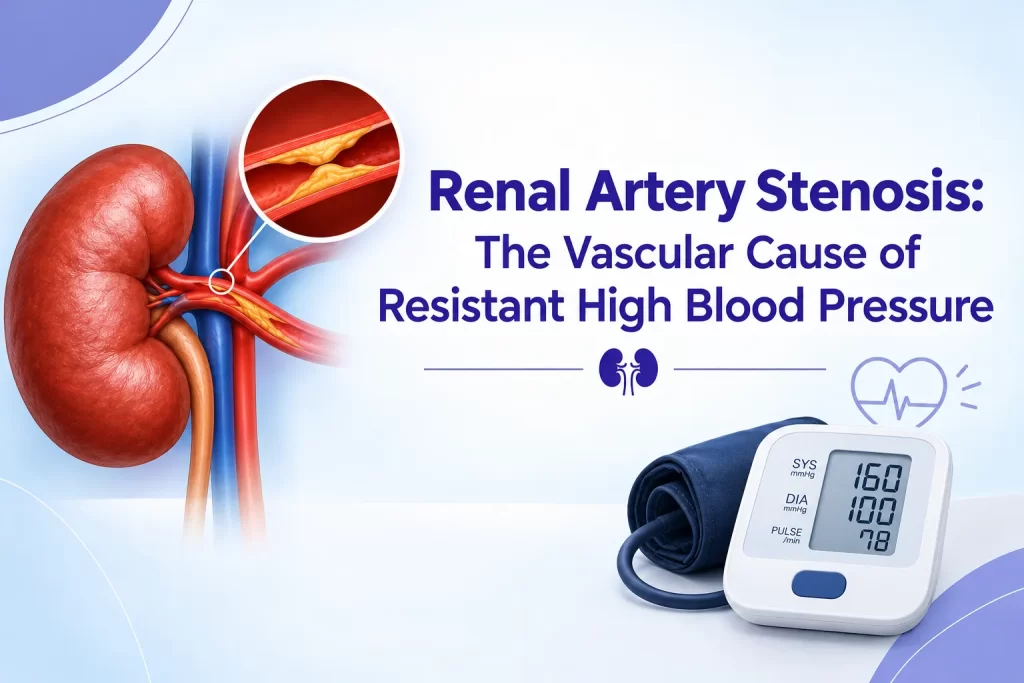
Renal artery stenosis is a condition in which one or both arteries supplying blood to the kidneys become narrowed. This narrowing may reduce blood flow to the affected kidney and trigger changes in the body’s blood pressure regulation system.
The renal arteries originate from the abdominal aorta and supply oxygen-rich blood to the kidneys. When one of these arteries becomes significantly narrowed, the affected kidney may interpret the reduced blood supply as a signal that blood pressure is too low.
In response, the body activates hormonal mechanisms that can cause blood vessels to constrict and encourage the kidneys to retain sodium and water. These changes can contribute to high blood pressure.
Renal artery stenosis can affect one kidney or both kidneys. Its effects depend on the degree of narrowing, the underlying cause, kidney function, and the patient’s overall health.
How Does Renal Artery Stenosis Cause Resistant High Blood Pressure?
Blood pressure is regulated by several interconnected systems, including the kidneys, blood vessels, nervous system, and hormones.
When blood flow through a renal artery is reduced, the affected kidney may activate the renin-angiotensin-aldosterone system (RAAS). This system helps regulate blood pressure and fluid balance.
Activation of this system can lead to:
- Narrowing of blood vessels
- Increased sodium and water retention
- Increased pressure within the circulation
- Additional strain on the heart and blood vessels
Over time, these changes may contribute to persistent hypertension.
What Is Resistant Hypertension?
Resistant hypertension generally refers to blood pressure that remains above the recommended target despite the use of three appropriately selected blood pressure medications, usually including a diuretic, at tolerated doses. It can also describe blood pressure controlled only with four or more medications.
Before diagnosing resistant hypertension, clinicians need to consider factors such as missed doses, inaccurate blood pressure measurements, medication interactions, and white-coat hypertension.
If blood pressure remains uncontrolled after these factors are addressed, the doctor may investigate secondary causes, including renal artery stenosis when the clinical findings suggest it.
What Causes Renal Artery Stenosis?
1. Atherosclerosis
Atherosclerosis occurs when fatty deposits, cholesterol, and other substances accumulate in the walls of arteries.
It is a common cause of renal artery stenosis, particularly in older adults and people with other cardiovascular risk factors. The narrowing often occurs near the origin of the renal artery from the aorta.
Risk factors include smoking, high cholesterol, diabetes, hypertension, and increasing age.
2. Fibromuscular Dysplasia
Fibromuscular dysplasia (FMD) is a condition that causes abnormal development of the walls of certain arteries. It can lead to narrowing, irregularity, or other structural changes in the renal arteries.
FMD is a different condition from atherosclerosis and may occur in younger adults. It is more frequently identified in women, although it can affect people of any sex.
3. Other Possible Causes
Less commonly, renal artery narrowing may occur due to inflammatory conditions affecting blood vessels, previous vascular procedures, or other structural abnormalities.
Identifying the underlying cause helps guide the diagnostic assessment and treatment plan.
What Are the Symptoms of Renal Artery Stenosis?
Renal artery stenosis often causes no specific symptoms in its early stages. It may be suspected when a doctor identifies unusual patterns of high blood pressure or changes in kidney function.
Possible clinical clues include:
- High blood pressure that is difficult to control
- A sudden onset or significant worsening of hypertension
- Hypertension that develops at an unusually young age
- A decline in kidney function without a clear explanation
- A noticeable deterioration in kidney function after starting certain blood pressure medications
- Recurrent episodes of sudden fluid accumulation in the lungs, sometimes associated with severe hypertension
A doctor may also investigate when imaging or a physical examination suggests disease affecting multiple arteries.
These findings do not prove that renal artery stenosis is present. They indicate that further evaluation may be appropriate.
Seek urgent medical attention for severe breathlessness, chest pain, confusion, or other symptoms that may indicate a hypertensive emergency or acute cardiovascular problem.
Who Is at Risk of Renal Artery Stenosis?
The likelihood of developing renal artery stenosis depends partly on its underlying cause.
People with atherosclerotic renal artery disease may have risk factors such as:
- Smoking or a history of tobacco use
- Diabetes
- High cholesterol
- Long-standing hypertension
- Other forms of arterial disease
- Increasing age
People with fibromuscular dysplasia may develop renal artery stenosis without the typical risk factors associated with atherosclerosis.
Having one or more risk factors does not necessarily mean that a person has renal artery stenosis. Testing should be guided by symptoms, clinical findings, and the treating doctor’s assessment.
How Is Renal Artery Stenosis Diagnosed?
Diagnosis involves assessing blood pressure, kidney function, medical history, and the structure of the renal arteries.
The doctor selects investigations according to the patient’s symptoms, clinical risk, kidney function, and whether the results are likely to change treatment.
1. Blood Pressure Assessment
Repeated blood pressure measurements help establish whether hypertension is persistent. Home blood pressure monitoring or ambulatory blood pressure monitoring may help identify white-coat hypertension and assess control outside the clinic.
The doctor also reviews prescribed medications, adherence, and other possible causes of uncontrolled blood pressure.
2. Blood and Urine Tests
Blood tests may include serum creatinine and estimated glomerular filtration rate (eGFR) to assess kidney function. Electrolytes may also be checked.
Urine testing can help identify protein or other abnormalities that may indicate kidney disease.
These tests cannot independently confirm renal artery stenosis, but they help assess its possible effects and guide further investigations.
3. Renal Artery Doppler Ultrasound
Doppler ultrasound uses sound waves to evaluate blood flow through the renal arteries.
It is non-invasive and does not use ionising radiation. In suitable patients, it can provide information about blood flow and suggest whether significant narrowing is present.
The accuracy of the examination can depend on technical factors, the patient’s anatomy, and the experience of the person performing the test.
4. CT Angiography (CTA)
CT angiography produces detailed images of the renal arteries and can help identify the location and extent of narrowing.
Because CTA uses contrast material and ionising radiation, the doctor considers kidney function, contrast-related risks, and the potential benefits before recommending it.
5. MR Angiography (MRA)
6. Catheter Angiography
Catheter-based angiography may be used when more detailed assessment is required, particularly if an intervention is being considered.
It involves introducing a catheter into the vascular system and injecting contrast to visualise the arteries. Because it is invasive, it is generally reserved for situations where the expected diagnostic or treatment benefit justifies the risks.
What Are the Treatment Options for Renal Artery Stenosis?
Treatment depends on the severity of the narrowing, blood pressure control, kidney function, the cause of the condition, and the patient’s overall cardiovascular risk.
Not everyone with renal artery stenosis requires a procedure. Many patients can be managed with medication and appropriate monitoring.
1. Medication and Blood Pressure Management
Blood pressure control is a central part of treatment.
Depending on the patient’s medical history and kidney function, the doctor may prescribe medicines such as ACE inhibitors, angiotensin receptor blockers (ARBs), calcium channel blockers, or diuretics.
These medicines require appropriate monitoring. In patients with suspected or confirmed renal artery stenosis, particularly when both kidneys are affected or a solitary functioning kidney is involved, some medications may cause a significant change in kidney function or potassium levels.
Patients should not start, stop, or change prescribed blood pressure medicines without medical guidance.
2. Lifestyle and Cardiovascular Risk-Factor Management
Managing cardiovascular risk factors is important, especially when atherosclerosis is responsible for the narrowing.
A personalised plan may include:
- Stopping smoking
- Following a balanced, heart-healthy diet
- Reducing excess dietary sodium when appropriate
- Maintaining regular physical activity according to medical advice
- Managing diabetes and cholesterol
- Taking prescribed medications consistently
These measures support cardiovascular health but do not necessarily reverse an established narrowing of the renal artery.
3. Renal Artery Angioplasty and Stenting
Renal artery angioplasty is a minimally invasive procedure that uses a catheter and a small balloon to widen a narrowed artery.
In selected cases, a stent – a small mesh tube – may be placed to help keep the artery open.
The procedure is performed under imaging guidance, usually through access in an artery. The treating team evaluates the patient’s vascular anatomy, kidney function, and potential procedural risks before deciding whether intervention is appropriate.
For more information, visit the dedicated renal artery stenosis stenting service page.
4. When Is Renal Artery Stenting Considered?
Renal artery stenting is not automatically recommended for everyone with renal artery stenosis.
For many patients with stable atherosclerotic disease, medical management provides appropriate care, and routine stenting has not consistently shown better outcomes than good medical therapy.
A procedure may be considered in selected circumstances, such as:
- Difficult-to-control hypertension when significant renal artery disease is believed to be contributing
- Recurrent episodes of sudden pulmonary oedema associated with significant renal artery disease
- Progressive loss of kidney function in selected patients, particularly when both kidneys or a solitary functioning kidney are affected
- Certain cases of fibromuscular dysplasia, depending on the anatomy and clinical findings
The decision requires individual assessment and, when appropriate, discussion between the treating physician, nephrologist, and vascular or endovascular specialist.
Can Treating Renal Artery Stenosis Improve Blood Pressure?
It can in selected patients, but the response varies.
When renal artery narrowing is a major contributor to hypertension, treatment may improve blood pressure control. Some patients may need fewer medications after an intervention, while others continue to require medication and regular monitoring.
The outcome depends on factors such as the cause and duration of hypertension, the severity of arterial narrowing, the condition of the kidneys, and the presence of other medical problems.
No procedure can guarantee that blood pressure will return to normal or that all blood pressure medication can be stopped.
The aim is to choose a treatment that offers the best balance of potential benefit and risk for the individual patient.
What Happens If Renal Artery Stenosis Is Left Untreated?
The effects vary considerably. Mild or stable narrowing may not cause significant problems, while more severe disease can contribute to complications in some patients.
Potential concerns include:
- Persistent or worsening hypertension
- Progressive kidney dysfunction in selected cases
- Increased cardiovascular strain
- Fluid overload or recurrent pulmonary oedema in certain high-risk patients
Regular clinical follow-up helps doctors monitor blood pressure, kidney function, and changes in the patient’s condition.
The appropriate approach may involve medical treatment, further investigations, surveillance, or a procedure when the expected benefits justify the risks.
When Should You Consult a Vascular Specialist?
Consider further medical evaluation if you have blood pressure that remains uncontrolled despite several prescribed medications, an unexplained decline in kidney function, or imaging results suggesting renal artery narrowing.
Your physician or nephrologist can assess whether a secondary cause of hypertension should be investigated. If renal artery stenosis is suspected or confirmed, a vascular or endovascular specialist may help evaluate whether medical management, angioplasty, or stenting is appropriate.
Learn more about renal artery stenosis stenting and treatment options.
You can also learn about balloon angioplasty and the wider range of vascular conditions treated by Dr. Kushan Nanavati.
Frequently Asked Questions
1. Can renal artery stenosis cause resistant high blood pressure?
2. Can renal artery stenosis damage the kidneys?
3. Can renal artery stenosis be treated without surgery?
4. Is renal artery stenting always necessary?
5. Does renal artery stenting cure high blood pressure?
6. Which doctor treats renal artery stenosis?
7. Is renal artery stenosis dangerous?
Conclusion
Renal artery stenosis is an important but not universal cause of resistant high blood pressure. It develops when one or both arteries supplying the kidneys become narrowed, potentially affecting the kidneys’ ability to regulate blood pressure.
Recognising relevant clinical clues, investigating the cause of persistent hypertension, and assessing kidney function can help guide appropriate care.
Treatment may involve medication and risk-factor management, while renal artery angioplasty or stenting may be appropriate for selected patients. The best approach is based on individual clinical findings and a careful assessment of potential benefits and risks.
Medical disclaimer: This article is for general educational purposes only and is not a substitute for professional medical advice, diagnosis, or treatment. Do not change blood pressure medication without consulting your treating doctor.