
You have changed the dressing a dozen times. Tried the ointment. Rested your leg. And still – that wound near your ankle is not going anywhere.
If this sounds familiar, you are dealing with something that goes beyond a simple skin problem. A wound that refuses to heal for more than two weeks is almost always a signal that something deeper is going on – usually with the veins in your leg. And unless that root cause is treated, no amount of dressing changes will give you lasting results.
This guide is for anyone in Vadodara who has been living with a chronic leg wound and wants to understand what is actually happening, what can be done about it, and what to expect from treatment.
What Is a Venous Leg Ulcer - and What Causes It?
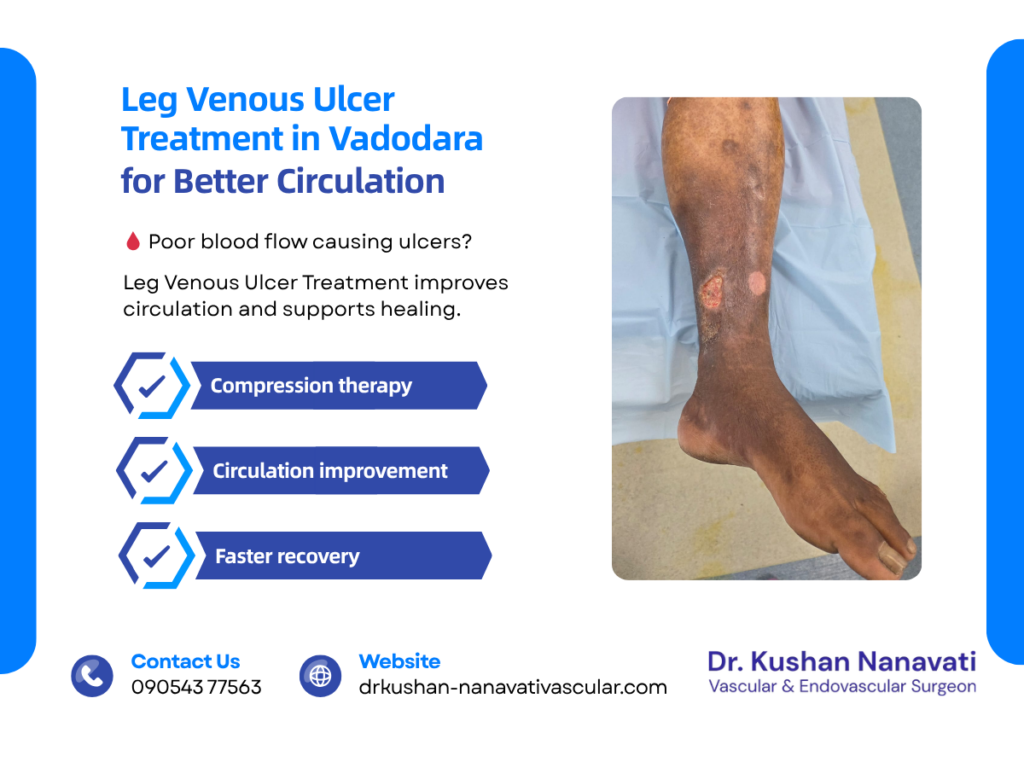
A venous leg ulcer is an open wound, usually on the lower leg or around the ankle, caused by poor blood flow in the veins. When the veins cannot return blood efficiently to the heart, pressure builds up. Over time, that pressure damages the skin from the inside out – and once it breaks down, an ulcer forms.
The most common reasons this happens:
- Varicose veins that have been left untreated for years
- Deep vein thrombosis (DVT) - even a clot that happened years ago can damage the vein valves permanently
- Chronic venous insufficiency (CVI) - where the one-way valves inside the veins simply stop working
- Prolonged standing or sitting, which puts constant strain on the leg veins over time
- Obesity, which increases pressure on the venous system
How Do You Know It Is a Venous Ulcer?
This matters more than most people realise. A diabetic foot ulcer, an arterial ulcer, and a venous ulcer can all look similar on the surface – but they need completely different treatments. Applying compression bandaging on an arterial wound, for example, can seriously worsen the condition.
Signs that point toward a venous ulcer:
- Located on the inner ankle or lower leg (not the foot or toes)
- Shallow wound with irregular, ragged edges
- Wound base is moist or weeping - not dry and black
- Surrounding skin looks brownish or reddish, and feels tight or hard
- The leg swells by the end of the day
- The ulcer itself may not be very painful, but the leg feels heavy and achy
How it is diagnosed:
A Doppler ultrasound scan is the standard test. It is completely non-invasive – no needles, no pain – and it shows your doctor exactly how blood is moving through both your veins and arteries. This scan is what separates proper diagnosis from guesswork, and it is the starting point for building a treatment plan that will actually work.
Treatment Options: What Actually Heals a Venous Leg Ulcer
There is no single magic fix – but there is a well-established approach that works when followed correctly.
Step 1 – Compression therapy
This is the foundation. A trained nurse or doctor applies multi-layer compression bandaging to your leg, which counteracts the abnormal venous pressure, reduces swelling, and creates the right conditions for the wound to heal. For many patients, this alone produces significant improvement within a few weeks – but only if it is applied correctly and worn consistently.
Step 2 – Treating the underlying vein problem
Compression manages the symptom. These procedures treat the cause:
- Endovenous laser or radiofrequency ablation - A thin wire is passed into the faulty vein and heat is used to close it permanently. Done under local anaesthesia, no hospital stay needed.
- Sclerotherapy - A solution is injected into smaller problem veins to collapse them. Usually takes a few sessions.
- Venoplasty - If there is a blockage deeper in the venous system, a small balloon is used to open it and a stent may be placed to keep it open. This is for more complex cases.
Step 3 – Proper wound dressing
The right dressing keeps the ulcer clean, moist, and protected while healing happens underneath. The type of dressing depends on the wound stage – your doctor will change this as the ulcer progresses.
When the Wound Still Won't Heal: Advanced Options
Most ulcers treated correctly will heal within 4 to 8 weeks. But some have been present for months or years, and they need a stronger approach.
Vacuum-Assisted Closure (VAC) / NPWT A small device applies gentle suction to the wound, removing excess fluid, reducing infection risk, and actively stimulating new tissue growth. It sounds intensive but is well-tolerated and has transformed outcomes for patients with stubborn wounds.
Hyperbaric Oxygen Therapy (HBOT) You breathe pure oxygen inside a pressurised chamber. This floods the wound area with oxygen-rich blood – particularly useful when poor circulation is limiting the body’s ability to repair itself.
Skin Grafting For very large ulcers, once the wound is clean and the vein problem is addressed, a thin layer of skin can be grafted onto the ulcer surface to speed up closure. This is not the first step – it is done after the groundwork is laid.
The key point: advanced treatments work best when the root vascular problem has already been dealt with. They are tools to finish the job, not bypass the process.
What You Can Do at Home to Speed Up Healing
Treatment does not happen only in the clinic. What you do every day has a real impact on how quickly your ulcer heals – and whether it comes back.
Things that help:
- Elevate your legs when resting - prop them up above hip level on cushions. Even 30-45 minutes a few times a day makes a difference.
- Walk regularly - short walks activate the calf muscle pump, which helps push blood upward through your veins. Sitting still for long periods is one of the worst things for venous circulation.
- Wear your compression stockings consistently - even after the ulcer heals. This single habit can cut recurrence risk by more than half.
- Keep the wound clean and dry between dressing changes - do not use antiseptic solutions (like Dettol or Betadine) directly on the ulcer unless specifically told to.
Things that slow healing:
- Smoking - it narrows blood vessels and significantly impairs circulation
- Being sedentary for long periods
- Leaving compression bandaging off because it feels uncomfortable
- Treating only the wound and ignoring the vein problem
Will It Come Back? Preventing Recurrence
Venous ulcers have a frustratingly high recurrence rate – without proper aftercare, up to 70% of patients develop a new ulcer within a few years. The reason is almost always the same: the vein disease was not fully treated, or compression was stopped too soon.
How to protect yourself after healing:
- Continue wearing compression stockings long-term - your vascular surgeon will advise the grade
- Attend follow-up appointments even when the wound looks fully healed
- If you notice the skin around your ankle becoming discoloured, itchy, or hard again - see your doctor early, before a new ulcer forms
- Manage conditions like diabetes, high blood pressure, or obesity that contribute to poor venous health
When Should You See a Vascular Surgeon?
See a vascular surgeon (not just a general physician) if:
- A wound on your lower leg has not healed in 2 weeks
- You have varicose veins and notice skin changes around the ankle
- Your leg swells consistently and the skin is darkening
- You have a history of DVT and have developed a new wound
- A wound was previously treated but has returned
A general doctor can provide wound dressings, but diagnosing and treating the underlying venous disease requires a vascular specialist. Dr. Kushan Nanavati, Vascular Surgeon in Vadodara, provides comprehensive assessment and minimally invasive venous leg ulcer treatment in Vadodara – from Doppler evaluation to endovenous procedures and advanced wound care – all under one roof.
Frequently Asked Questions
1. What is the fastest way to heal a venous leg ulcer?
2. Does a venous ulcer always need surgery?
3. How long before I see improvement?
4. Can I walk with a venous ulcer?
5. What happens if I leave it untreated?
6. Can varicose veins cause leg ulcers?
7. I had an ulcer before and it healed. Why has it come back?
Conclusion
A non-healing leg wound is not something you have to simply manage or put up with. In most cases, it can be fully healed – and with the right vascular care, it does not have to come back.
The process is not complicated, but it does require treating the vein problem, not just the wound. Compression, the right procedure, good wound care, and a few consistent daily habits – that combination works.
If you have been dealing with a leg wound that is not improving, the most useful thing you can do right now is get a proper vascular assessment. The earlier you start, the simpler the treatment, and the better the outcome.