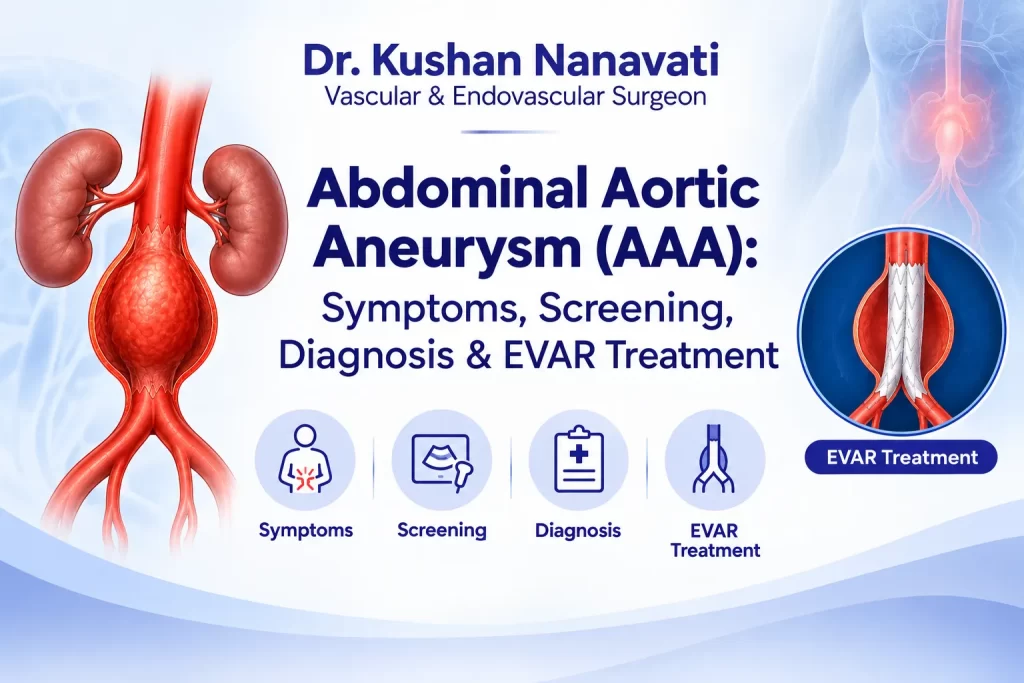

An abdominal aortic aneurysm (AAA) is a potentially serious vascular condition in which a section of the aorta – the body’s main artery – becomes enlarged or weakened. One of the biggest concerns is that an AAA often develops without noticeable symptoms, making early detection and appropriate medical evaluation important.
Understanding the warning signs, risk factors, diagnostic tests, and available treatment options can help people make informed decisions about their vascular health.
In this guide, we explain what an abdominal aortic aneurysm is, who may be at risk, how doctors diagnose it, and how endovascular aneurysm repair (EVAR) may be used to treat selected patients.
What Is an Abdominal Aortic Aneurysm (AAA)?
The aorta carries oxygen-rich blood from the heart to the rest of the body. An abdominal aortic aneurysm occurs when part of the aorta within the abdomen becomes abnormally enlarged due to weakening of the artery wall.
Aneurysms can develop gradually and may increase in size over time. If an aneurysm becomes large enough or its wall weakens significantly, it can rupture, causing severe internal bleeding. A ruptured AAA is a life-threatening medical emergency.
Not every abdominal aortic aneurysm requires immediate surgery. Management depends on factors such as the aneurysm’s diameter, growth rate, symptoms, overall health, and individual risk of rupture.
What Are the Symptoms of an Abdominal Aortic Aneurysm?
One of the most challenging aspects of AAA is that it often causes no symptoms in its early stages. Many aneurysms are discovered incidentally during imaging performed for another medical reason.
When symptoms occur, they may include:
- Persistent abdominal discomfort or pain
- Pain in the lower back
- A pulsating sensation in the abdomen
- Abdominal tenderness in some cases
These symptoms can have many possible causes and do not necessarily indicate an aneurysm. However, persistent or unexplained abdominal or back pain should be medically evaluated.
Emergency Warning Signs of a Ruptured AAA
A ruptured abdominal aortic aneurysm can cause sudden, severe abdominal or back pain, dizziness, fainting, collapse, or signs of shock.
If a rupture is suspected, seek emergency medical care immediately. Do not wait for a routine appointment.
Prompt recognition and emergency treatment are essential because a ruptured aneurysm can cause life-threatening blood loss.
What Causes an Abdominal Aortic Aneurysm?
An AAA develops when the wall of the aorta weakens. The process can involve age-related changes, inflammation, atherosclerosis, and other factors affecting the strength of the artery wall.
In many patients, there is no single identifiable cause.
Several factors can increase the likelihood of developing an abdominal aortic aneurysm.
1. Increasing Age
2. Smoking
3. High Blood Pressure
4. Family History
5. Atherosclerosis and Vascular Disease
6. Other Individual Risk Factors
Sex, certain inherited connective tissue disorders, and other medical conditions may influence an individual’s risk.
People with relevant risk factors should discuss their need for assessment or screening with a qualified healthcare professional.
What Is AAA Screening, and Who May Need It?
Abdominal Ultrasound
Abdominal ultrasound is a commonly used, non-invasive test for detecting an abdominal aortic aneurysm. It uses sound waves to produce images of the aorta and measure its diameter.
The examination is generally painless and does not use ionising radiation.
Who Should Consider Screening?
Screening decisions depend on a person’s age, sex, smoking history, family history, and other risk factors. Recommendations can vary between healthcare systems.
A clinician may consider an aortic ultrasound for someone with a strong family history or other relevant risk factors, even if the person has no symptoms.
Screening is not necessary for everyone. A healthcare professional can help determine whether it is appropriate in an individual case.
How Is an Abdominal Aortic Aneurysm Diagnosed?
When an AAA is suspected or discovered, further assessment helps determine its size, location, anatomy, and potential risk.
Common diagnostic investigations include:
1. Abdominal Ultrasound
Ultrasound can identify an aneurysm and measure its maximum diameter. It is also useful for monitoring an aneurysm over time.
2. CT Angiography
CT angiography (CTA) provides detailed images of the aorta and surrounding blood vessels. It can help assess the aneurysm’s dimensions, its relationship to important arterial branches, and the anatomy required for treatment planning.
CTA is particularly useful when a patient is being evaluated for possible EVAR.
3. Additional Clinical Assessment
The treating specialist considers symptoms, medical history, cardiovascular risk factors, aneurysm growth, and overall health when determining the appropriate management plan.
The aim is to identify patients who can be monitored safely and those who may benefit from repair.
What Is EVAR Treatment for Abdominal Aortic Aneurysm?
Endovascular aneurysm repair (EVAR) is a minimally invasive procedure used to treat selected abdominal aortic aneurysms.
Rather than opening the abdomen to repair the aorta directly, the specialist introduces a stent graft through an artery, usually accessed through the groin. Using imaging guidance, the stent graft is positioned inside the affected section of the aorta.
Once deployed, the graft creates a channel for blood to flow through, helping exclude the aneurysm from direct blood pressure and reduce the risk of rupture.
How Is EVAR Performed?
The procedure generally involves the following steps:
- Pre-procedure assessment: Imaging and medical evaluation help determine whether the patient’s anatomy is suitable for EVAR.
- Vascular access: The specialist accesses the relevant artery, commonly through the groin.
- Stent-graft placement: The graft is guided into the aorta and positioned across the aneurysm.
- Imaging confirmation: The specialist checks graft placement and blood flow and evaluates for leaks.
- Post-procedure monitoring: The patient is monitored for recovery and possible complications.
The exact approach depends on the patient’s anatomy, the device used, and the treating team’s clinical judgement.
What Are the Potential Benefits of EVAR?
For appropriately selected patients, EVAR may offer several advantages compared with open surgical repair:
- Smaller access incisions
- Less extensive surgical trauma
- A shorter hospital stay in many cases
- Faster initial recovery in many patients
However, EVAR is not suitable for every aneurysm. It also carries risks, including bleeding, vascular injury, graft-related complications, and endoleak, in which blood continues to flow into the aneurysm sac.
Patients need ongoing imaging surveillance after EVAR to assess the graft and monitor the aneurysm.
EVAR vs. Open Surgery: What Is the Difference?
Both EVAR and open surgical repair aim to reduce the risk of aneurysm rupture, but they use different approaches.
| Feature | EVAR | Open Surgical Repair |
|---|---|---|
| Approach | Catheter-based, minimally invasive | Open abdominal surgery |
| Repair Method | Stent graft placed inside the aorta | Surgical graft attached to the aorta |
| Initial Recovery | Often shorter | Usually longer |
| Suitability | Depends on aneurysm anatomy and patient factors | Depends on operative risk and clinical factors |
| Follow-up | Long-term imaging surveillance is required | Follow-up is also necessary |
Neither approach is universally best. The choice depends on aneurysm anatomy, age, general health, operative risk, patient preferences, and specialist assessment.
Does Every Abdominal Aortic Aneurysm Require Surgery?
No. Small, asymptomatic aneurysms may be managed with regular imaging surveillance and risk-factor management rather than immediate repair.
Treatment decisions may depend on:
- Maximum aneurysm diameter
- Rate of aneurysm growth
- Presence of symptoms
- Overall health and expected procedural risks
- Suitability for EVAR or open surgery
The specialist may recommend periodic ultrasound or other imaging, smoking cessation, blood pressure management, and treatment of relevant cardiovascular risk factors.
Repair may be considered when an aneurysm reaches a size associated with increased rupture risk, grows rapidly, or causes symptoms. The appropriate threshold and timing must be determined by a qualified vascular specialist.
Recovery and Follow-Up After EVAR
Recovery varies according to the patient’s health, the complexity of the procedure, and whether any complications occur.
After EVAR, the medical team monitors the access site, circulation, kidney function when relevant, and overall recovery.
Patients should follow their discharge instructions regarding activity, medication, wound care, and follow-up appointments.
Why Is Follow-Up Imaging Important?
EVAR does not eliminate the need for ongoing monitoring. Follow-up imaging helps detect endoleaks, changes in aneurysm size, graft movement, and other complications.
The type and frequency of surveillance depend on the patient’s risk profile, previous imaging findings, and the treating specialist’s recommendations.
Keeping scheduled appointments is an important part of long-term care.
When Should You Consult a Vascular Specialist?
Consider a vascular assessment if you have a known abdominal aortic aneurysm, a relevant family history, significant risk factors, or an imaging report that identifies an enlarged aorta.
A vascular specialist can assess your condition, explain the available management options, and determine whether monitoring, additional investigations, or repair may be appropriate.
For information about vascular conditions and available specialist services, visit Dr. Kushan Nanavati’s vascular surgery website.
You can also explore information aboutdiabetic foot care and vascular conditions on the website.
Frequently Asked Questions
1. Can an abdominal aortic aneurysm occur without symptoms?
2. Which test is used to detect AAA?
3. Is EVAR a major surgery?
4. Is EVAR suitable for every patient with AAA?
5. How long does recovery after EVAR take?
6. Can an abdominal aortic aneurysm be monitored without surgery?
7. Is follow-up necessary after EVAR?
Conclusion
An abdominal aortic aneurysm is a potentially serious vascular condition that may remain silent until it becomes dangerous. Recognising risk factors, obtaining appropriate assessment, and following a personalised monitoring or treatment plan can help reduce the risk of serious complications.
EVAR offers a minimally invasive treatment option for selected patients, but the most appropriate approach depends on careful imaging assessment and specialist evaluation.
If you have concerns about an abdominal aortic aneurysm or have received an abnormal imaging report, consult a qualified vascular specialist to discuss the next steps.
Medical disclaimer: This article is intended for general educational purposes and is not a substitute for professional medical advice, diagnosis, or treatment. Sudden, severe abdominal or back pain, especially with fainting or collapse, requires immediate emergency medical attention.