
For patients undergoing hemodialysis, choosing the right dialysis access is an important part of long-term kidney care. Dialysis access provides a reliable way to remove blood from the body, filter waste and excess fluid through a dialysis machine, and return the cleaned blood to circulation.
Three common types of hemodialysis access are Permacath, arteriovenous (AV) fistula, and arteriovenous (AV) graft. Each option has different advantages, limitations, and suitability depending on the patient’s kidney condition, blood vessel health, and dialysis requirements.
Understanding the differences between these options can help patients and families have informed discussions with their nephrologist and vascular surgeon.
In this guide, we explain how Permacath, AV fistula, and AV graft work, compare their benefits and risks, and discuss how doctors choose the most appropriate dialysis access.
What Is Dialysis Access and Why Is It Important?
Hemodialysis is a treatment that removes waste products and excess fluid from the blood when the kidneys cannot perform these functions adequately.
During treatment, blood must travel from the body to the dialysis machine and then return safely. Dialysis access provides the route for this process.
A suitable access should provide adequate blood flow, allow reliable dialysis sessions, and minimise complications such as infection, clotting, and access failure.
The choice of access depends on several factors, including:
- How urgently dialysis needs to begin
- Whether dialysis is expected to continue for an extended period
- The size and condition of the patient’s arteries and veins
- Previous dialysis access procedures
- Overall health and other medical conditions
- The patient’s preferences and long-term treatment plan
Planning dialysis access early can help preserve suitable blood vessels and reduce the likelihood of needing a temporary catheter for longer than necessary.
What Is a Permacath for Dialysis?
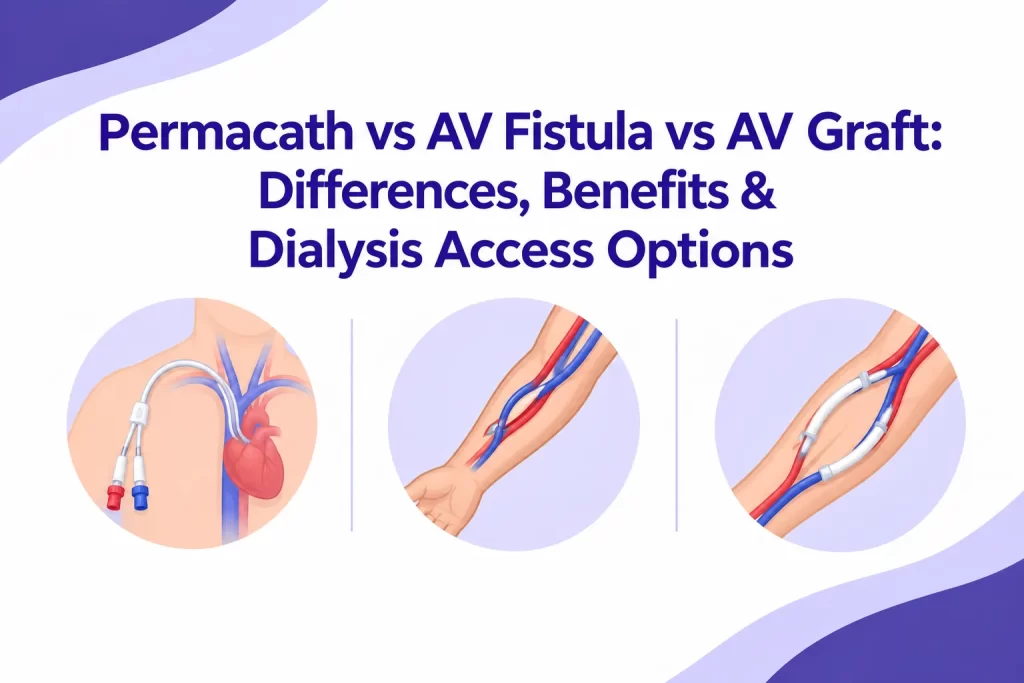
A Permacath is a type of tunneled central venous catheter used for hemodialysis. It is inserted into a large vein, usually in the neck, with the catheter tip positioned in a central vein near the heart.
The catheter has separate channels that allow blood to flow to the dialysis machine and return to the body.
Unlike an AV fistula or AV graft, a Permacath does not require a surgical connection between an artery and a vein in the arm. It can often be used relatively soon after placement once the treating team confirms that it is functioning correctly.
Benefits of a Permacath
- Can provide dialysis access when treatment must begin urgently
- Can be used while an AV fistula matures or an AV graft becomes ready for use
- Does not require repeated needle insertion into an arm access
- May be appropriate for selected patients who cannot undergo AV access creation
Risks and Limitations of a Permacath
A Permacath carries a higher risk of bloodstream infection than an AV fistula or AV graft. It may also develop blood clots, become blocked, or experience reduced blood flow.
Catheters can sometimes cause narrowing of the central veins, which may affect future dialysis access options.
For these reasons, a Permacath is often used as a bridge to another access or for specific clinical circumstances. However, longer-term use may be appropriate for selected patients when other options are unsuitable or inconsistent with their care goals.
Patients should keep the catheter dressing and exit site clean and dry according to their dialysis team’s instructions.
What Is an AV Fistula?
An arteriovenous fistula, commonly called an AV fistula or AVF, is created surgically by connecting an artery to a vein, usually in the arm.
The increased blood flow from the artery causes the vein to enlarge and strengthen over time. This process is known as maturation and helps prepare the vein for repeated needle insertion during hemodialysis.
An AV fistula is often preferred for suitable patients who need long-term hemodialysis because a successfully matured fistula can provide durable access with a relatively low risk of infection.
Benefits of an AV Fistula
- Generally lower infection risk than a dialysis catheter
- Can provide durable access for long-term hemodialysis
- Uses the patient’s own blood vessels
- May require fewer long-term maintenance procedures when it functions well
Risks and Limitations of an AV Fistula
An AV fistula does not become usable immediately in every patient. It requires time to mature, and some fistulas do not develop sufficient blood flow or vein size for reliable dialysis.
Possible complications include:
- Failure to mature
- Narrowing of the access blood vessels
- Blood clot formation
- Bleeding or aneurysmal enlargement
- Reduced blood flow to the hand in some patients
- Increased workload on the heart in selected cases
The vascular surgeon assesses the arteries and veins before recommending fistula creation. Ultrasound mapping may help identify suitable vessels and guide the choice of access location.
How Long Does an AV Fistula Take to Mature?
Maturation time varies between patients. Some fistulas become usable within several weeks, while others need longer or require additional procedures.
The access should be assessed by the dialysis and vascular care team before it is used. Patients should not assume that a fistula is ready for dialysis based only on how long ago it was created.
What Is an AV Graft?
An arteriovenous graft, or AVG, is another type of surgically created dialysis access. It connects an artery to a vein using a synthetic tube or another suitable graft material.
The graft is placed beneath the skin, commonly in the arm, and provides a route for blood to flow between the artery and vein. During dialysis, needles are inserted into the graft to access the bloodstream.
An AV graft may be considered when the patient’s veins are not suitable for a fistula or when a more rapid route to usable access is needed.
Benefits of an AV Graft
- May be suitable when native veins are inadequate for AV fistula creation
- Often becomes usable sooner than a conventional AV fistula
- Provides an alternative for patients with challenging vascular anatomy
- Certain specialised early-cannulation grafts can be used relatively soon after placement when clinically appropriate
Risks and Limitations of an AV Graft
An AV graft generally has a higher risk of infection and clotting than a well-functioning AV fistula. Narrowing can develop where the graft connects to the vein, sometimes requiring angioplasty or other maintenance procedures.
Other possible complications include bleeding, graft infection, reduced blood flow to the hand, and graft failure.
Regular monitoring helps identify problems early and maintain reliable dialysis access.
Permacath vs AV Fistula vs AV Graft: Key Differences
The most appropriate dialysis access depends on the patient’s clinical circumstances rather than a single option being best for everyone.
| Feature | Permacath | AV Fistula | AV Graft |
|---|---|---|---|
| Type | Tunneled venous catheter | Surgical artery-to-vein connection | Artery-to-vein connection using a graft |
| Location | Usually a large vein in the neck | Usually the arm | Usually the arm |
| Time to Use | Often soon after placement if cleared | Requires maturation | Often usable sooner than a conventional fistula |
| Infection Risk | Generally highest | Generally lowest | Higher than a fistula |
| Blood Clot Risk | Can become blocked or clot | Can clot | Can clot and may need maintenance |
| Long-Term Use | Used in selected circumstances | Often preferred when suitable | Useful alternative when suitable veins are unavailable |
| Maintenance | Catheter care and monitoring | Monitoring and possible interventions | Monitoring and possible interventions |
Which Dialysis Access Is Best: Permacath, AV Fistula or AV Graft?
There is no single access option that is best for every patient.
For many patients who need long-term hemodialysis, a mature, functioning AV fistula is preferred when the patient’s vessels and clinical circumstances make it suitable. An AV graft can be a valuable alternative when a fistula is unlikely to mature or when dialysis needs make an earlier usable access important.
A Permacath may be necessary when dialysis must start urgently, while an AV fistula or graft is being prepared, or when surgical access is not a suitable option.
The decision should take into account:
- The urgency of dialysis
- Expected duration of hemodialysis
- Artery and vein size and quality
- Previous access procedures and complications
- Infection risk and other health conditions
- The patient’s goals and preferences
Current vascular access guidance supports an individualised approach that considers the patient’s overall kidney treatment plan, rather than automatically choosing the same access for everyone.
How Do Doctors Choose the Right Dialysis Access?
1. Clinical Assessment
The doctor reviews the patient’s kidney disease, treatment history, medical conditions, and expected dialysis needs.
2. Blood Vessel Mapping
Ultrasound mapping may be used to assess the arteries and veins, identify suitable access sites, and help plan the procedure.
3. Considering the Timing of Dialysis
4. Developing a Long-Term Access Plan
The care team considers not only the initial access but also how it will be monitored, what may happen if it fails, and which future options should be preserved.
This approach helps reduce avoidable complications and supports continuity of dialysis treatment.
How to Care for Your Dialysis Access
AV Fistula and AV Graft Care
- Check the access daily for changes in appearance, swelling, redness, or discomfort.
- Follow your dialysis team’s instructions for keeping the access clean.
- Avoid tight clothing or jewellery that compresses the access arm.
- Avoid blood pressure measurements, blood draws, or intravenous lines in the access arm unless your treating team specifically advises otherwise.
- Learn how to check the usual vibration, known as the thrill, if your dialysis team recommends it.
- Attend scheduled reviews and report changes promptly.
Permacath Care
- Keep the catheter dressing clean, dry, and intact.
- Do not remove caps or manipulate the catheter yourself.
- Follow the dialysis team’s instructions for bathing and catheter protection.
- Contact your healthcare team promptly if the dressing becomes wet, loose, or contaminated.
- Seek urgent medical advice for fever, chills during dialysis, redness, discharge, or pain around the catheter site.
Important: A sudden loss of the usual fistula thrill, a cold or painful hand, significant bleeding, or signs of infection require prompt medical assessment.
What Are the Signs of Dialysis Access Failure?
Dialysis access problems may develop gradually or occur suddenly.
Warning signs include:
- Reduced or absent vibration in an AV fistula or graft
- Swelling of the arm or hand
- Redness, warmth, or discharge around an access site
- Unusual bleeding after dialysis
- Difficulty inserting dialysis needles
- Repeated alarms or inadequate blood flow during dialysis
- Fever or chills in a patient with a dialysis catheter
If the access stops functioning, contact the dialysis team urgently. Prompt assessment may allow treatment before the access is permanently lost.
Severe bleeding that does not stop with direct pressure, or symptoms such as fainting or severe breathlessness, require emergency medical care.
When Should You Consult a Vascular Surgeon for Dialysis Access?
A vascular surgeon may be involved when a patient needs a new AV fistula or graft, has an unsuitable or failed access, or develops complications that affect dialysis.
Specialist evaluation may also be appropriate when an AV fistula does not mature, an access repeatedly clots, or narrowing reduces blood flow.
Depending on the problem, treatment may involve access creation, angioplasty, thrombectomy, revision, or another intervention.
You can enquire about the availability of services including AV fistula creation, AV graft creation, AV fistula salvage angioplasty, and Permacath placement.
Frequently Asked Questions
1. Is an AV fistula better than a Permacath?
2. What is the difference between an AV fistula and an AV graft?
3. How long does an AV fistula take to become usable?
4. Can an AV graft be used sooner than an AV fistula?
5. Can a Permacath be used for long-term dialysis?
6. What happens if an AV fistula fails to mature?
7. Which doctor creates dialysis access?
Conclusion
Permacath, AV fistula, and AV graft are three important options for hemodialysis access. Each serves a different purpose, and the right choice depends on the patient’s blood vessels, urgency of treatment, kidney condition, and long-term dialysis plan.
An AV fistula is often preferred for suitable patients requiring long-term hemodialysis, while an AV graft may be appropriate when native veins are unsuitable. A Permacath remains important when dialysis must begin quickly or other access options are not feasible.
Early planning, appropriate access selection, and regular monitoring can help reduce complications and support reliable dialysis treatment.
If you or a family member needs dialysis access planning or is experiencing access-related problems, consult a qualified vascular specialist and nephrologist to discuss the most appropriate options.
Medical disclaimer: This article is intended for general educational purposes only and is not a substitute for professional medical advice, diagnosis, or treatment. Dialysis access decisions should be made with your treating healthcare team.